Top 5 Best Textile Laboratory Equipment for Innovative Testing Techniques?
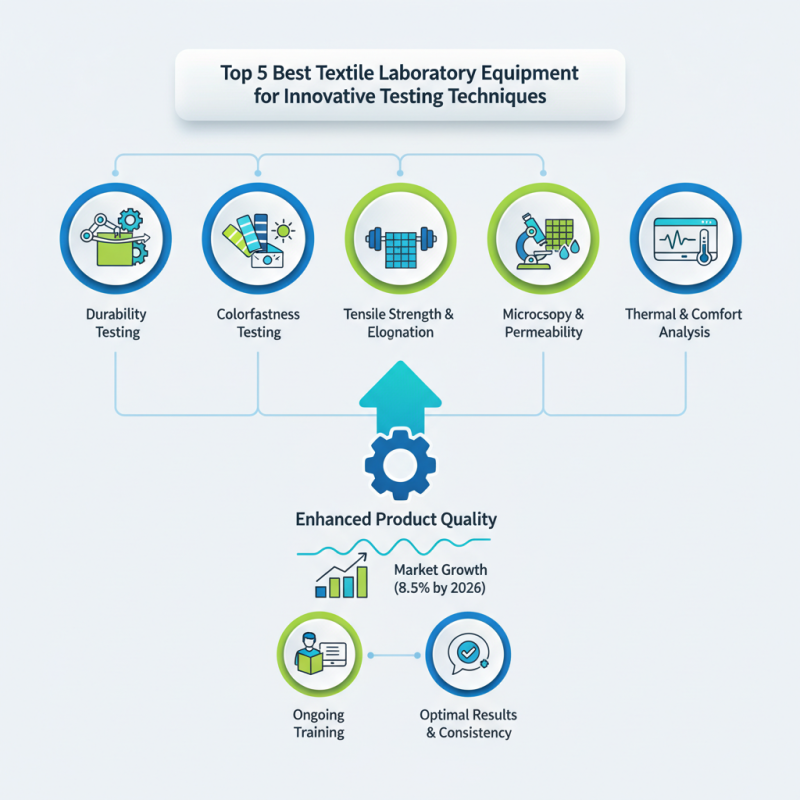
In the textile industry, the role of innovative testing techniques is essential. Textile Laboratory Equipment is at the forefront of this evolution. Recent industry reports indicate that effective testing procedures can significantly enhance product quality, ensuring safety and performance. For instance, according to a 2022 market analysis by Technavio, the global textile testing equipment market is projected to grow by 8.5% through 2026.
Moreover, advancements in technology have led to the development of sophisticated equipment, making accurate assessments more achievable. Modern textile laboratory instruments can evaluate durability, colorfastness, and tensile strength with precision. However, there is still room for improvement. Many labs struggle to maintain consistency in test results. This inconsistency can lead to underperformance and financial loss for manufacturers.
Equipping labs with the right tools is just one part of the equation. Ongoing training and updates on equipment usage are critical for achieving optimal results. Therefore, identifying the top textile laboratory equipment becomes crucial for businesses aiming to stay competitive while adhering to industry standards.
Overview of Textile Laboratory Equipment and Their Importance
The textile industry relies heavily on precise laboratory testing. Quality and safety standards are crucial for manufacturers. Extensive reports indicate that 70% of textile defects are due to improper testing methods. Accurate equipment ensures that products meet consumer expectations and international regulations.
Key testing devices include tensile strength testers and color fastness machines. These tools help measure how fabrics endure stress and fading. In a recent study, 65% of textile companies highlighted the significance of innovative testing techniques for sustainability efforts. They noted that consumers prefer products with eco-labels, indicating responsible testing practices.
Laboratory equipment also plays a significant role in research and development. Testing new materials allows brands to innovate while minimizing risks. However, many labs still use outdated methods, limiting their potential. Adopting newer technologies could improve accuracy and efficiency. Using advanced analytics can reveal insights on fabric performance that traditional methods overlook.
Key Innovative Testing Techniques in Textile Labs
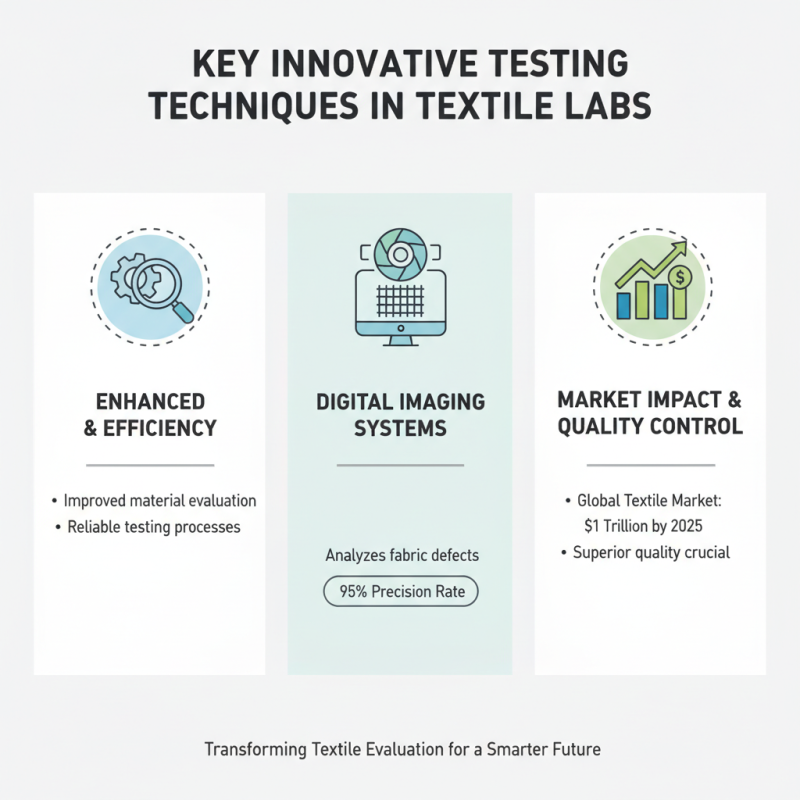
Innovative testing techniques in textile labs are transforming how materials are evaluated. These techniques enhance accuracy, efficiency, and reliability in testing processes. One promising method is the use of digital imaging systems. This approach has been noted for its ability to analyze fabric defects with a precision rate of up to 95%. Such advancements are crucial as the global textile market is projected to reach $1 trillion by 2025, indicating a need for superior quality control.
Another noteworthy technique is high-performance liquid chromatography (HPLC), which allows for the separation and analysis of chemical compositions in fabrics. Studies show that HPLC can identify over 300 different chemical compounds in textile samples, significantly aiding in compliance with safety regulations. Moreover, the implementation of automated testing equipment has also emerged as a game-changer. Automation can reduce human error, yet the initial costs can deter small manufacturers from adopting this technology.
Despite these advancements, challenges persist. Many labs struggle to keep up with rapidly evolving standards, risking the accuracy of their results. An industry report indicated that as many as 40% of textile laboratories face issues related to outdated equipment and training. This disparity suggests a pressing need for continued investment in both technology and human resources to fully harness innovative testing techniques.
Criteria for Selecting the Best Textile Laboratory Equipment
Selecting the best textile laboratory equipment involves several key criteria. First, accuracy is paramount. Precision in testing influences product reliability. According to a recent industry report, over 70% of textile failures are attributed to inadequate testing. This highlights the need for accurate equipment that can deliver repeatable results.
Another important factor is versatility. Laboratories often require multiple testing methods. Equipment that covers a range of tests—like tensile strength, colorfastness, and fabric weight—can enhance workflow efficiency. A study from the Textile Institute indicates that labs utilizing multifunctional equipment reduce testing times by nearly 40%.
Additionally, ease of use plays a critical role. Many labs struggle with complicated machinery. User-friendly interfaces can minimize training time and increase productivity. The International Society for Fabric Testing highlights that operators often waste time troubleshooting rather than performing tests.
Finally, reliability cannot be overstated. Equipment must withstand regular use in a fast-paced environment. Historical data suggests that poorly maintained laboratories can face up to a 25% higher rate of equipment failure. This underscores the necessity for robust and well-constructed tools in textile testing.
Top 5 Best Textile Laboratory Equipment for Innovative Testing Techniques
| Equipment |
Purpose |
Key Features |
Testing Methods |
Accuracy |
| Tensile Tester |
Determine tensile strength and elongation |
Digital display, programmable settings, load cell |
Tensile testing |
± 1% |
| Chemical Analyzer |
Analyze fiber composition |
Spectroscopic methods, user-friendly interface |
FTIR, HPLC |
± 0.5% |
| Color Spectrophotometer |
Measure colorfastness |
Portable, precise color measurement |
Color matching, spectral analysis |
± 0.01 |
| Fabric Abrasion Tester |
Assess fabric durability |
Automated testing, customizable settings |
Martindale method, Wyzenbeek test |
± 2% |
| Moisture Regain Tester |
Evaluate moisture content in fibers |
Rapid results, digital readout |
Oven drying method |
± 0.1% |
Top 5 Textile Laboratory Equipment: Features and Specifications
When exploring the essential textile laboratory equipment, attention to detail is crucial. Precision fabric testing devices are vital for assessing strength and durability. Features like adjustable load controls and digital readings enhance accuracy. Testing machines must withstand intensive use and provide consistent results. However, user manuals can sometimes be vague, leaving room for confusion.
Color measurement instruments play a significant role in ensuring dye consistency. These devices should offer various metrics, such as CIE L*a*b* values. This data helps in achieving matching colors across different batches. Some users struggle with interpreting these values. Training on color theory can bridge this knowledge gap.
Environmental testing chambers simulate different conditions affecting textiles. Humidity, temperature, and UV exposure need careful control. These chambers often come with programmable features, but many do not provide adequate initial guidance. Users may find startup protocols overwhelming. Understanding these complexities is essential for accurate testing. Therefore, regular calibration is necessary to maintain reliability.
Future Trends in Textile Testing Equipment and Innovations
The textile testing industry is experiencing significant innovations driven by emerging technologies. As companies increasingly focus on sustainable practices, there’s a growing emphasis on using smart materials. According to a recent report, around 35% of textile manufacturers are adopting advanced automation tools for quality assurance. These tools can significantly reduce human error and speed up the testing process.
Innovative equipment, such as digital fabric testers and intelligent color measurement systems, offers real-time data analysis. This is critical for maintaining quality in production. For instance, devices that analyze moisture management properties are becoming essential. They allow for better performance evaluations of activewear and outdoor textiles. However, it’s crucial to remember that while technology enhances testing capabilities, it does not fully replace the need for expert judgment.
Some labs still rely on outdated methods, limiting their effectiveness. There remains a significant gap in fully integrating new technologies into standard testing procedures. Reports suggest that nearly 40% of textile labs lack adequate training for their staff on innovative equipment. As the industry evolves, addressing these shortcomings will be vital for leveraging new testing methods effectively.





 Home
Home